
 admin
admin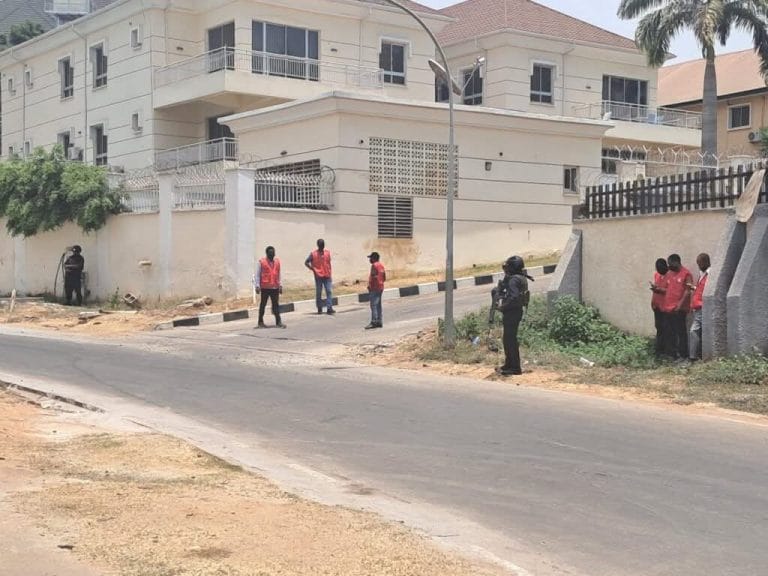
Operatives of the Economic and Financial Crimes Commission (EFCC) on Tuesday restricted access to the Abuja residence of former Attorney-General of the Federation, Abubakar Malami.
The operatives were said to have arrived in multiple vehicles and positioned themselves along Koranakh Close, off Amazon Street, Maitama, Abuja, effectively limiting movement within the area.
Residents and visitors were reportedly unable to gain entry to the street as security presence increased around the location.
The operatives, dressed in EFCC-branded jackets, were seen stationed at strategic points within the neighbourhood.
Access to the residence, located at No. 2 Koranakh Close, was also restricted during the operation.
As of the time of filing this report, the EFCC had not issued an official statement regarding the development, and the specific reason for the operation remains unclear.
Malami has denied the multiple criminal charges filed against him, accusing the Federal Government of witch hunt.
Malami is currently facing a 16-count charge bordering on alleged money laundering alongside his wife, Bashir Asabe, and son, Abdulaziz.
Speaking in an interview with DCL Hausa, the former minister described his recent legal and custodial experiences as part of a broader life journey, while insisting he would contest the allegations in court.
“I have spent time in EFCC custody, Kuje Prison, and with the DSS. I believe it is all God’s will, and I accept it, but I will defend myself against the allegations,” he said.
Malami was initially released from custody before being rearrested on January 19 by operatives of the Department of State Services (DSS). Two days later, he alleged that he was denied access to his family members and legal representatives while in detention.
On February 27, a Federal High Court in Abuja granted him and his son bail in the sum of N200 million each over separate allegations linked to terrorism-related offences.
The former minister also raised concerns about the conduct of security agencies during the investigation, alleging that his rights were breached.
“They violated my rights by searching my houses and business premises without notifying me during the investigation,” he had said.
“Constitutionally, I have the right to be present during a search to oversee the investigation of my property and to know exactly what is being looked for or taken.”
Despite the ongoing legal battle, Malami maintained that he stands by his record in public office.
“I have no regrets regarding what I did during my time as a minister,” he had stated.