 admin
admin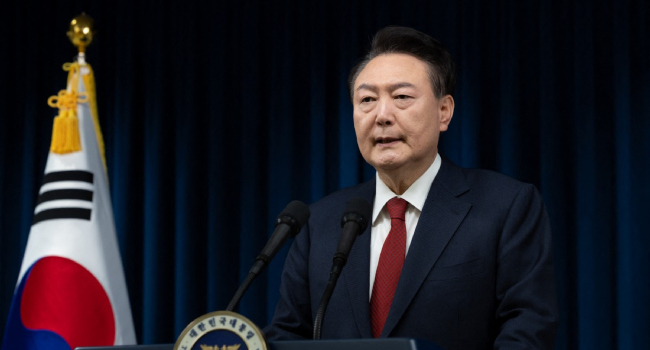
South Korea’s President Yoon Suk Yeol was banned from leaving the country on Monday, the justice ministry said, less than a week after he plunged the country into chaos by briefly imposing martial law.
Yoon sent special forces and helicopters to parliament on the night of December 3 before lawmakers forced him to rescind the order by rejecting his decree.
The hugely unpopular leader narrowly survived an impeachment motion in parliament on Saturday even as huge crowds braved freezing temperatures to call for his ouster.
However, despite remaining in office, a clutch of investigations has been closing in on Yoon and his close allies, including a probe for alleged insurrection.
The Ministry of Justice confirmed on Monday that Yoon had become the first sitting South Korean president to be banned from leaving the country.
A lawmaker was asked at a parliamentary hearing on Monday whether Yoon had been banned from leaving the country. “Yes, that’s right,” Bae Sang-up, an immigration services commissioner at the ministry, replied.
Also under travel bans for their roles in last week’s events are former defence minister Kim Yong-Hyun – currently in detention—and ex-interior minister Lee Sang-min.
General Park An-su, the officer in charge of the martial law operation, and defence counterintelligence commander Yeo In-hyung are also barred from leaving the country.
Investigators hauled Park in for further questioning on Monday.
‘Second coup’
The impeachment push failed to pass after members of Yoon’s own People Power Party (PPP) walked out of parliament, depriving it of the necessary two-thirds majority.
The PPP says that in exchange, Yoon, 63, has agreed to hand power to the prime minister and party chief, prompting howls of protest from the opposition.
“This is an unlawful, unconstitutional act of a second insurrection and a second coup,” Democratic Party floor leader Park Chan-dae said on Monday.
Under South Korea’s constitution, the president remains head of government and commander in chief of the army unless he or she is incapacitated, resigns, or steps down.
In such a case, power would then be handed to the interim prime minister until elections could be held.
Claiming that Yoon can remain in office but has delegated his powers to the prime minister and leader of his ruling PPP—who is not elected—is “a blatant constitutional violation with no legal basis,” Park said.
“Their attitude of placing themselves above the constitution mirrors that of insurrectionist Yoon Suk Yeol,” he said.
Power vacuum?
The defence ministry confirmed on Monday that the embattled Yoon remained at the head of the country’s security apparatus, despite the apparent power vacuum in a country that remains technically at war with nuclear-armed North Korea.
“Legally, (control of military forces) currently lies with the commander in chief,” Defence Ministry spokesperson Jeon Ha-Kyou said.
Yoon has apologised for the “anxiety and inconvenience” caused by his declaration of martial law but has not stepped down, saying instead he would entrust decisions about his fate to his party.
He also said he would accept all political and legal responsibility for the martial law fiasco.
There is no constitutional basis supporting the ruling party’s claim that Yoon can stay in office but hand over his power to unelected party officials, said Kim Hae-won, a constitutional law professor at Pusan National University Law School.
“It seems to resemble an unconstitutional soft coup,” he told AFP.
“If there are issues with the president, there are ways laid out in the constitution, such as suspending the president from his duties, and then move on to proceedings set out in the constitution, such as impeachment,” he said.
The opposition has already said they would try again to impeach Yoon, with leader Lee Jae-Myung saying another vote would be held on Saturday.
Huge crowds are expected to gather again outside the National Assembly building.
According to a new Gallup poll commissioned by local media, Yoon’s approval rating hit 11 per cent, a historic low for the unpopular president.
AFP