 admin
admin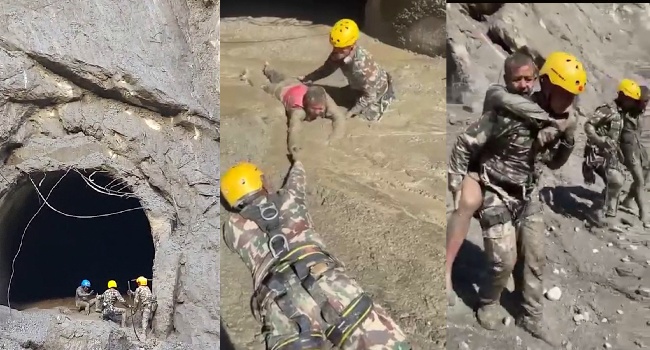
Devastating floods on the Nepal-Tibet border region this week have killed at least 547 people, Nepal’s police said on Friday.
Chinese state media earlier confirmed five dead following Wednesday’s disaster, taking the total killed to at least 552.
More than 1,400 people are missing, including hundreds of foreigners.
The US Geological Survey said the disaster — the deadliest for Nepal since a 2015 earthquake — was caused by a glacial collapse that triggered a vast flow of icy debris.
In addition, Indian authorities recovered seven bodies from rivers flowing from Nepal, believed to be victims of the devastating floods, officials said Friday.
Authorities are working to identify the bodies, and the seven bodies in India are not included in the overall toll.
The deluge of ice and mud also caused huge pools of water to form, with one of these formations bursting on Friday in Tibet in a new threat to emergency workers scouring the region for survivors.
Nepali police urged all rescuers to “immediately move to a safe location,” saying it had received information that “a water dam has burst again on the Tibetan side”.
Separately in Tibet, China had earlier on Friday paused its rescue operation at the hardest-hit area of Gyirong over the risk of renewed flooding.
State broadcaster CCTV reported that a lake formed by immense piles of debris has begun overflowing towards the area that rescue teams were headed.
“So all rescue teams have been ordered to stand by in place and wait for further instructions,” it said, adding that emergency teams which had earlier accessed the area “have been ordered to withdraw one kilometer”.
At a meeting chaired by Chinese President Xi Jinping on Friday, leaders underlined “many hidden dangers of glaciers, ice lakes and geological disasters in the surrounding area” and warned that “rescue is facing great difficulties,” Xinhua reported.
‘Tunnel Rescue Operation’
Emergency teams had been racing to retrieve survivors from affected zones, where the widespread devastation meant food and water supplies were running out.
The Nepali military had meanwhile located people trapped in the tunnel of Trishuli 3A hydropower project, where they are working to find a way in to retrieve the survivors.
“Two helicopters have been dispatched, but it is challenging because it is tough to even locate the entry points of the tunnel,” army spokesman Raja Ram Basnet said.
Some 350 workers and residents have been brought to safety from the site, he added, but efforts were ongoing to extract more than 100 people trapped in the same area.
Workers rescued from other dam projects along the Trishuli valley described a disaster that unfolded with terrifying speed.
Worker Buddha Tamang said he survived only because he was inside a tunnel at the dam where he worked when the flood struck — but he had managed to get out and reach help.
“I survived as I was in the tunnel,” said Tamang, who was airlifted on Thursday after being marooned for more than 24 hours.
“The senior officers working on the other side, they were all swept away.”
‘Washed Away’
Survivors in a makeshift Nepali hospital endured an agonising wait for news of their missing loved ones.
Kula Priya, whose eldest son is missing, said she had lost everything when the deluge hit.
“I don’t care for wealth. I just want my son back. If any of you could rescue my son, please do it for me,” she said.
“I don’t know where to go. We had three houses, all of which were washed away by the floods.”
Nepali police have reported a death toll of 469 people.
In India, authorities said they had recovered seven bodies from rivers flowing from Nepal, believed to be flood victims.
There are 910 people, including 517 foreign tourists, who are out of contact in Nepal. Indians make up the largest number of missing foreigners, while the United States said 90 of its citizens were out of contact.
Across the border in Tibet, which is largely inaccessible to foreign journalists and where the only sources of information are Chinese authorities — officials say hundreds are missing and three died.
Authorities also said they had evacuated 555 stranded tourists and 499 Chinese residents from Tibet.
Pilgrimage Route
Scores of Hindu devotees from across the world are among those missing on the border, as many were on a pilgrimage to Mount Kailash on the Chinese side.
Logadarrsiny Raman, 26, from Malaysia, said she lost contact with her parents, aunt and uncle, who were on a pilgrimage.
Raman said the travel agency told her the last contact with the group of 17 Malaysians was on Wednesday morning, when they were travelling towards the Nepal-China border.
The flood crashed into the area where they were last contacted soon after.
“I’m very anxious,” she said. “My only hope is to hear back from them that they are safe.”
AFP