 admin
admin
The World Bank has raised alarm over the threat of insecurity and COVID-19 pandemic on Nigerian households’ food security.
In a new report, “COVID-19 in Nigeria: Frontline Data and Pathways for Policy”, released in Washington, last night, the bank said Nigeria “already faced complex development challenges, the pandemic continues to affect health outcomes, human capital accumulation, household poverty and coping strategies, and labour-market dynamics.”
The report is coming on the heels of similar concerns variously raised by prominent Nigerians, including former governor of Sokoto State, Alhaji Attahiru Bafarawa, and Minister of Defence, Major Gen Bashir Magashi, retd, investment experts, the Organised Private Sector, OPS, and other international bodies over the effect of insecurity on food security in the country.
The report, however, contradicted the latest inflation report released earlier in the week by the National Bureau of Statistics, NBS, which indicated that Nigeria’s inflation rate moderated for the seventh consecutive month to 15.99% YoY in October from 16.63% recorded in September 2021, while food inflation, the major driver of the headline inflation, dropped to 18.34% YoY in October from 19.57% recorded in September 2021.
Investment experts have, however, attributed the deceleration in both core and food inflation to the base effect from 2020, saying price pressures like relatively low harvest volumes, chronic supply chain bottlenecks, and limited access to FX through official channels remained significant.
Speaking on the inflationary pressure, analysts at Cordros Capital, a Lagos-based investment banking firm, said: “Prices of farm produce increased by 6 base points to 1.13% m/m (September: 1.07% m/m) despite October being the primary harvest season. From our channel checks, we understand that the harvest was below average due to persistent security challenges, lower than typical access to inputs due to below-average income, and flooding.
“Indeed, Famine Early Warning Systems Network (FEWSNET) reported that prices for both staple and cash crops remain significantly above the five-year average and last year. Besides, we think consumers might have started front-loading purchases of foodstuff in anticipation of a festive-induced price increase in the last two months of the year.”
Meanwhile, the World Bank report showed both the extent of these impacts on Nigerians and promising policy options that could accelerate the nation’s recovery.
The report draws on innovative sources of high-frequency data, namely, the Nigeria COVID-19 National Longitudinal Phone Survey, NLPS, to inform the choices that Nigeria’s leaders now face.
The World Bank stated: “The report shows that the consequences of the COVID-19 crisis for human capital, livelihoods, and welfare are proving to be severe.
“While many schools have reopened across Nigeria, learning that was lost during the COVID-19 crisis still needs to be recouped and some children have not returned to school.
“Even though many Nigerians have returned to work, the jobs to which they have shifted — mainly in small-scale non-farm enterprises — may not offer income security, making it difficult for households to escape poverty.
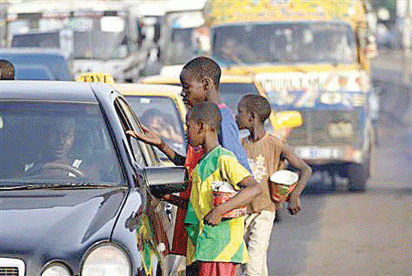
“With the COVID-19 crisis ushering in associated shocks – especially to food prices – and social protection remaining rare, households’ food security and their welfare at large is under serious threat.
“The rise in prices witnessed between June 2020 and June 2021 alone could push another six million Nigerians into poverty, with urban areas being disproportionately affected. This underscores the need for short-term policies to support welfare.
“The simple simulations suggest that the share of Nigerians living below the national poverty line could have increased from 40.1 percent to 42.8 percent due to the food price inflation witnessed between June 2020 and June 2021.
“This means about 5.6 million additional Nigerians would be living in poverty. While food price inflation would decrease purchasing power and raise poverty across Nigeria, it appears that urban areas could be disproportionately affected.
“In 2018/19, about 16 percent of poor Nigerians were urban dwellers. Yet among those who would be newly impoverished by the increase in food prices between June 2020 and June 2021, around 27 percent would be from urban areas.
“Nevertheless, poverty in Nigeria is set to remain a primarily rural phenomenon, with or without rising food prices.”
The findings underscored the urgency of far-reaching reforms to strengthen Nigeria’s economy and development outcomes.
Commenting on the report, World Bank Country Director for Nigeria, Shubham Chaudhuri, said: “The COVID-19 crisis has provided a wake-up call to address the long-standing structural challenges that could constrain the government’s ambition to lift 100 million Nigerians out of poverty.
“There is no time like the present for the country to prepare for future climate and conflict shocks and seize the promise of its young population to lay strong foundations for inclusive growth.”
The report suggested rolling out vaccines quickly and equitably to reduce the direct health threat posed by the virus.
It added that it would be essential to help children remediate the learning losses incurred during the pandemic – by getting them back to school or by finding low-tech remote solutions that work for the poor; as well as an expansion of the social protection which could provide short-term relief for the welfare losses currently faced by Nigerian households. A fallout from the security issues has now led to rise in default by farmers in the Central Bank of Nigeria’s Anchor Borrowers Programme (ABP).
A recent report by the CBN showed that of N615.4 billion disbursed to farmers since November 2015 when the programme started, only N152.3 billion, representing 25 percent of the total loans, had been repaid, while N463 billion, representing 75 percent of the total loans disbursed, was still outstanding.
“For the Anchor Borrowers Programme, the sum of N615.4billion had been disbursed to 3.04 million beneficiaries, out of which, N152.3billion was repaid,” CBN stated in the report.
Credit: Vanguard